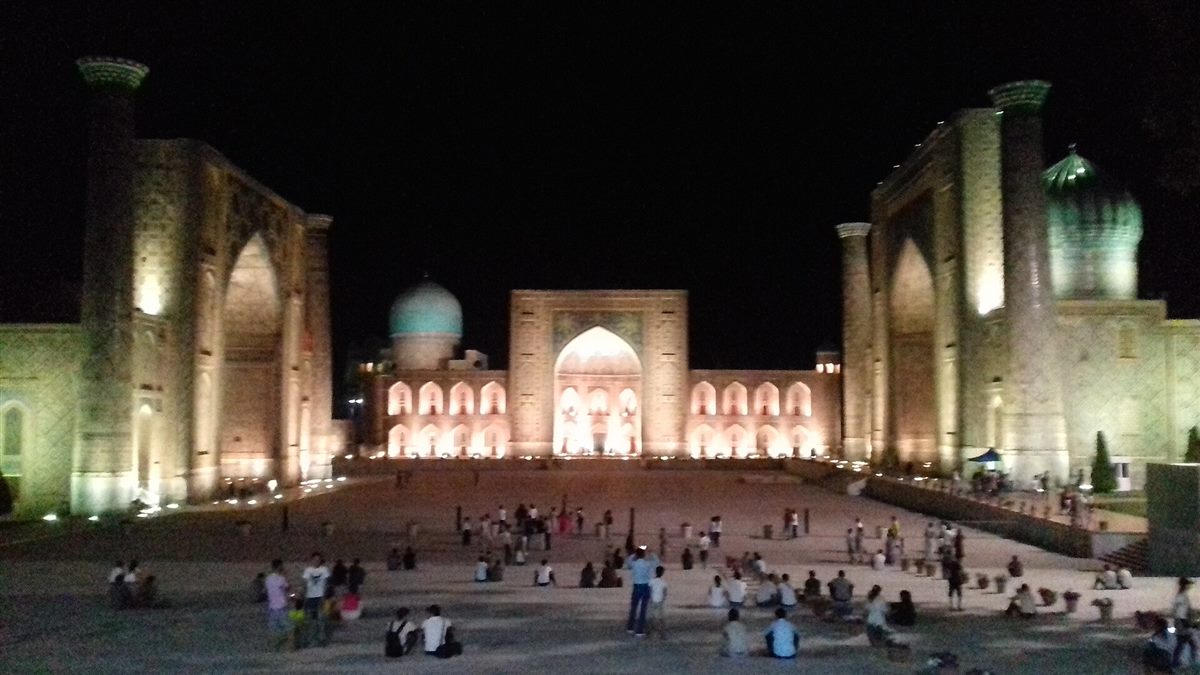
It's past 10pm and Registan Square, packed with people just an hour earlier, is starting to empty out. The souvenir sellers are packing up their stalls, the last tour groups are climbing back into their air-conditioned buses, and we're left standing alone on the still-warm pavement.
By day, the Registan is spectacular but noisy: selfies multiply in front of the Ulugh Beg, Tilla-Kari and Sher-Dor madrasas, guides recite their commentary in several languages, and you sometimes have to wait to photograph the square without anyone in the frame. At night, everything changes.
Silence rediscovered
The turquoise ceramic and gold mosaic facades, lit by soft, carefully designed lighting, take on another dimension. You can make out the details more clearly: the Quranic verses calligraphed across the pediments, the floral motifs repeating endlessly, the eight-pointed stars adorning the domes.
"You don't visit the Registan, you sit down and let it tell you three centuries of Timurid history."
A few Uzbek families still wander the square, children run between the arches, a corn-on-the-cob vendor pushes his little cart along the edge. It's a suspended moment, far from the daytime tourist bustle, where you finally grasp the real scale of the place: these madrasas weren't designed for cameras, but to impress entire caravans arriving from Persia, India or China.
Practical tip
If there's one piece of advice to take from this article: plan to come back to Registan Square in the late evening, after dinner, even if you've already visited during the day. The madrasas themselves usually close around 7-8pm, but the square stays open and lit much later. In our opinion, this is the most beautiful time to photograph it and to truly feel it.
Allow a good hour, with no guide or watch, just to let yourself be carried by the atmosphere. It's also the perfect time to chat with the few remaining vendors, who are often more available and warmer than during the day.